
General
Molasses is a thick, dark syrup obtained as a byproduct during the refining of sugarcane or sugar beets into sugar. Its composition varies based on sugar content, extraction method, and plant maturity. It is widely used for sweetening and flavoring products and contains concentrated vitamins and minerals naturally present in sugarcane. Molasses is classified into cane and beet types, with blackstrap molasses being the final stage from which no more sugar can be economically extracted.
Main composition of molasses at 75 % Dry Matter.
| Name | Cane molasses | Beet molasses |
|---|---|---|
| Sucrose | 30 – 40 % | 48 – 52 % |
| Reducing sugars | 15 – 20 % | 0.2 – 1.2 % |
| Organic non-sugar matter | 9 – 12 % | 12 – 17 % |
| Sulphated ash | 3 – 11 % | 3 – 10 % |
Solubility
Molasses exhibits varying solubility characteristics depending on its composition. The presence of reducing sugars generally decreases the solubility of sucrose, while inorganic ash tends to increase it.
Viscosity
The viscosity of molasses is influenced by factors beyond sugar content, including dry matter, temperature, and composition. Beet molasses typically has lower viscosity than cane molasses at ambient temperatures, though both are affected by dry matter levels. Molasses demonstrates a phenomenon known as critical viscosity, where viscosity increases rapidly beyond a certain concentration, usually between 81 and 85º Brix for cane molasses. Temperature also plays a key role, as an increase of 10ºC can significantly reduce viscosity.
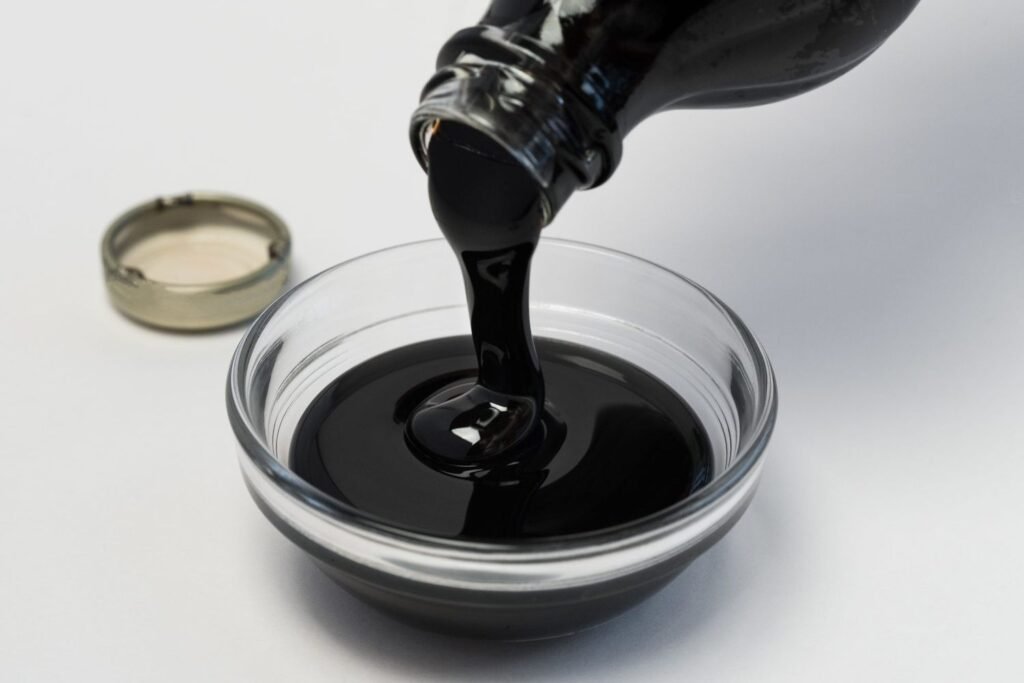
Molasses is a non-Newtonian fluid, meaning its flow properties are affected by multiple factors such as storage conditions, fermentation, Brix value, and temperature during handling. The Brix value, which measures sugar concentration, typically ranges between 80 and 90 and directly impacts thickness and pumpability. Higher Brix values result in thicker molasses, making discharge more difficult.

Explosion and Health Hazard data
Fermentation in molasses leads to an increase in volume, formation of foam, and a rise in temperature. It is often accompanied by an alcoholic or acidic odour. This process can be controlled by introducing air, which inhibits anaerobic bacterial activity.
Molasses is non-flammable and non-toxic; however, fermentation can release carbon dioxide along with traces of ethanol vapours, creating potential inhalation hazards in confined spaces. It may also react with strong acids such as concentrated nitric and sulfuric acid, requiring careful handling and storage.
